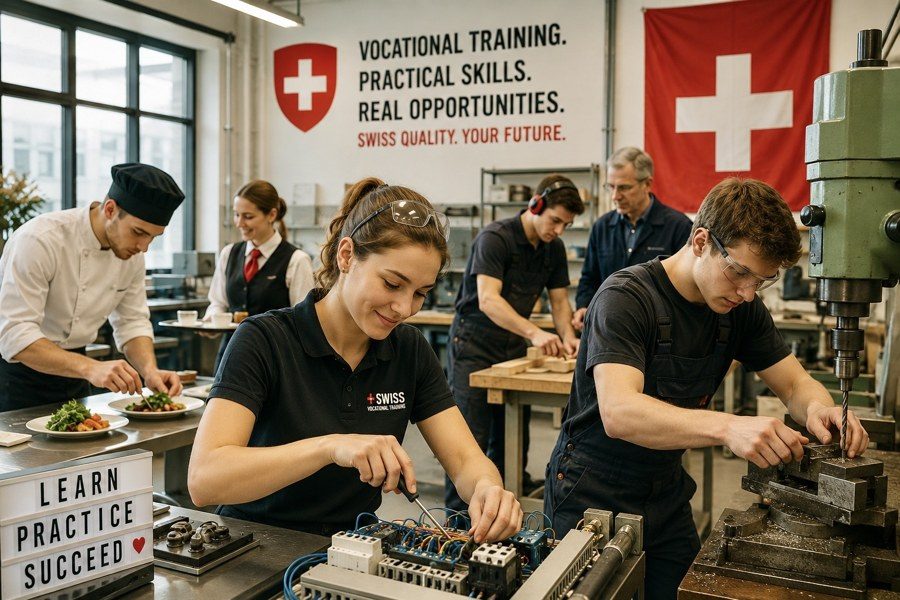


As AI transforms the labour market, it appears that vocational education is emerging as one of the safest and smartest career paths. While automation is expected to reshape many white-collar professions, skilled trades remain far less vulnerable.
AI may automate parts of legal work, architecture, accounting and other office-based professions. But when your heating fails in the middle of winter, you will not ask ChatGPT to fix your boiler. When your house needs rewiring, your pipes burst, or your grandparents require compassionate care, you will rely on skilled people—not algorithms.
The future of work is not simply about producing more software engineers. It is about ensuring society has the electricians who build renewable energy systems, the plumbers who maintain essential infrastructure, the welders who manufacture critical equipment and the care workers who support an ageing population.
As AI reshapes the economy, vocational education should no longer be seen as a fallback option. It should be recognised for what it increasingly is: one of the most resilient, valuable and future-proof pathways into the labour market.
Whether you are a recent high school graduate, a career changer or a foreign professional looking to relocate and train for a highly sought-after and well-paid job in Switzerland, here are the top options in Switzerland to go vocational:
Other excellent vocational schools
Two strong alternatives for technology, engineering and business-focused pathways.
1. WISS Schools ⭐ Best for IT
Best courses
- ICT Specialist EFZ
- Software Development
- Cybersecurity
- Systems Engineering
- Business Informatics
Typical tuition
ICT EFZ: the programme combines school-based training with a paid internship. View the official WISS ICT Specialist EFZ programme and current fees →
Ideal for
People wanting to enter Switzerland’s high-demand IT sector.
2. ipso Education ⭐ Best for engineering and business
Best courses
- Business Administration (HF)
- Electrical Engineering
- Mechanical Engineering
- Building Technology
- Process Engineering
- Business Informatics
Typical tuition
HF programme fees vary by subject, campus and cantonal subsidy eligibility. View official ipso programmes and current fees →
Ideal for
Students seeking federally recognised Swiss higher vocational qualifications.
Which school should you choose?
If your goal is the highest-paying career in Switzerland
These vocational fields currently offer some of the best long-term prospects. Salary ranges are indicative and vary by canton, experience and qualification; compare them with the Swiss Federal Statistical Office’s Salarium calculator and current job-market data.

- ICT / Cybersecurity — CHF 80,000–130,000+
- Electrician (EFZ) — CHF 70,000–100,000+
- HVAC / Heating Technician — CHF 75,000–110,000+
- Industrial Automation Technician — CHF 80,000–120,000+
- Plumber / Sanitary Installer — CHF 70,000–100,000+
- Medical Radiology Technician — CHF 75,000–110,000+
- Dental Hygienist — CHF 85,000–120,000+
If your objective is maximising employability in the AI era, I would recommend WISS (IT) or ipso (engineering/automation) if you enjoy technology, and Benedict if you prefer healthcare, languages, or business administration.
NUMBERS DON’T LIE
According to a report by the European Centre for the Development of Vocational Training (Cedefop), AI could reduce overall EU employment by around 5%, with 19%–68% of workplace tasks exposed to automation depending on the occupation. Vocational professions, however, are significantly less exposed than most non-vocational jobs. Occupations such as electricians, plumbers, welders, insulation workers and social care assistants are expected to remain in high demand as Europe undergoes the green, digital and demographic transitions.
Yet vocational education still suffers from an outdated image. Too often it is viewed as a “second choice” for students whose exam results were disappointing or who are perceived as less academically talented.
The evidence tells a different story.
According to Eurostat’s employment data for recent graduates, around 80% of recent graduates from upper secondary vocational education are employed, compared with roughly 67% of graduates from general education—a gap of around 13 percentage points.
Vocational training also tends to be considerably more affordable than a university degree while often leading to stable employment, competitive wages and, in many cases, additional income through tips or self-employment opportunities.
SWISS SECTORS WITH AN ACUTE SHORTAGE OF SKILLED WORKERS
According to a UBS article citing the University of Zurich’s Skills Shortage Index, workers are currently in short supply in Switzerland mainly in technical and manual professions. Almost a third of all vacancies on the Swiss labour market are difficult or impossible to fill. Sectors that are central to the Swiss economy are particularly badly affected.
The IT and technology sector does not have enough specialists in software development, cybersecurity and data management. The shortage of nurses and medical staff is especially noticeable in the healthcare sector. There is also a lack of qualified specialists in engineering, construction and education. In addition, workers are in high demand in interdisciplinary professions such as logistics, transportation and skilled trades in almost every sector.
Read the UBS skilled-worker-shortage article →
Explore a vocational path in Switzerland
Get personalised guidance on schools, entry routes, career options and the practical steps involved in studying or retraining in Switzerland.
Request a free consultation← Back to the main page