Short answer: yes, students can work — and they should, when it fits their studies
Business and hotel management school students in Switzerland can work student jobs, and my answer is: yes, definitely, they should. Student work is a great way to earn additional pocket money during academic semesters. It also increases experience on a CV, teaches valuable practical skills, helps students collect referrals and improves real-life confidence alongside the academic knowledge acquired at university.
However, the realities of student work are very important. Based on my experience with more than 100 students, students are most likely to realistically do student work during their academic semester if they are located on a city campus, such as the BHMS campuses in Lucerne or Zurich, or the Hotel Institute Montreux campus in Montreux. When the campus is in or close to a city, students can more easily reach restaurants, hotels, shops, events, offices, logistics companies and customer-service employers.
It is much less realistic for students staying on mountain campuses, such as Swiss Hotel Management School, Glion or Les Roches mountain locations, to travel down 30–40 minutes to a city and then return another 30–40 minutes back to campus just to work a short shift in McDonald’s, a supermarket, a café or as a waiter or waitress. Some students do it, but families should not assume it will be easy or routine.
It is also important to emphasize that student jobs are usually not glamorous. They often include working in McDonald’s, as a sales assistant, waiter or waitress, hotel service assistant, event helper or in the logistics department of a large supermarket chain. These jobs are not there to predict what the student will work as in the future. They are there so the student can make extra money, avoid asking parents for pocket money, buy daily extras independently, gain Swiss work habits and become more employable.
For adult or self-sponsored students, student work may also help with a faster return on investment of their studies or contribute towards the next tuition payment. It should not be treated as a full financial plan, but it can make a meaningful difference.
Why Swiss hospitality and business students actually have time to work
Swiss business and hotel management universities are not like high schools or traditional state universities where students sit in class from 9 a.m. to 5 p.m. every day. They give students a lot more independence, which allows actual time to work, gain experience, network and collect references even during the academic semester.
This is why I believe student work is a great addition to the guaranteed paid internship semesters offered by many Swiss hospitality and business programmes. Internships give structured professional experience related to a student’s field. Student jobs add something different: responsibility, punctuality, communication, resilience, local employer references and real-life Swiss workplace exposure.
Together, academic semesters, student work and paid internships can boost a student’s academic expertise, years of working experience on the CV, practical skills and bank account. Student work should not be viewed as a distraction when done responsibly and within the legal limits. It can become one of the most valuable parts of the Swiss education experience.
For programme planning, students should also compare hospitality programmes, business degrees, guaranteed paid internships, all-inclusive tuition fees and post-graduation options before deciding where to study.
The official rule: 15 hours per week during studies
The Swiss State Secretariat for Migration (SEM) explains that foreign students at a university or university of applied sciences may work a supplementary activity if the competent cantonal authority approves it. The activity may begin no sooner than six months after the start of the course and is limited to a maximum of 15 hours per week outside holidays. Source: SEM FAQ – Working.
Geneva’s official student-permit guidance gives a practical canton example: ancillary student work may not exceed 15 hours per week and 40 hours per week during university holidays. It also states that an application for an ancillary activity must be requested from the Cantonal Office for Population and Migration using Form E and must include a school letter of agreement. Source: Canton Geneva – ancillary activity for students.
EU/EFTA vs non-EU/EFTA students
| Student type | During academic semester | During official holidays | When can work start? | Approval / notification |
|---|---|---|---|---|
| EU/EFTA student | Usually up to 15 hours per week if residing primarily as a student | Full-time work is commonly allowed during official semester breaks | Generally from the start once properly registered, depending on canton procedure | Paid activity must be announced or registered with the competent local/cantonal authority |
| Non-EU/EFTA student | Usually up to 15 hours per week | Full-time / around 40 hours per week during official holidays, subject to canton approval | Normally no earlier than six months after starting studies | Employer usually files request; student should wait for approval before starting |
| Mandatory internship | May be treated separately if required by the study programme | Depends on internship duration and canton approval | Before the internship begins only after school/employer/canton procedure | School confirmation and employer documentation are usually required |
| After graduation job-search stay | Accessory work may be possible, often up to 15 hours per week | Not a full open work permit | After graduation from a Swiss higher-education institution | Canton issues the job-search residence authorisation |
Zurich confirms that employers must apply for student employment authorisation and that work outside semester breaks must not exceed 15 hours per week. Source: Canton Zurich – students and interns. Vaud similarly explains accessory work during studies and the procedure for studies/residence. Source: Canton Vaud – stay for studies.
How Swiss hospitality career offices help students work legally
Career offices at Swiss business and hotel management schools can issue the documents that eligible students need in order to do approved student work during the academic semester. The anonymised BHMS example below shows the type of school confirmation that may support a student work request: it confirms enrolment, programme structure and the permitted student-work framework.
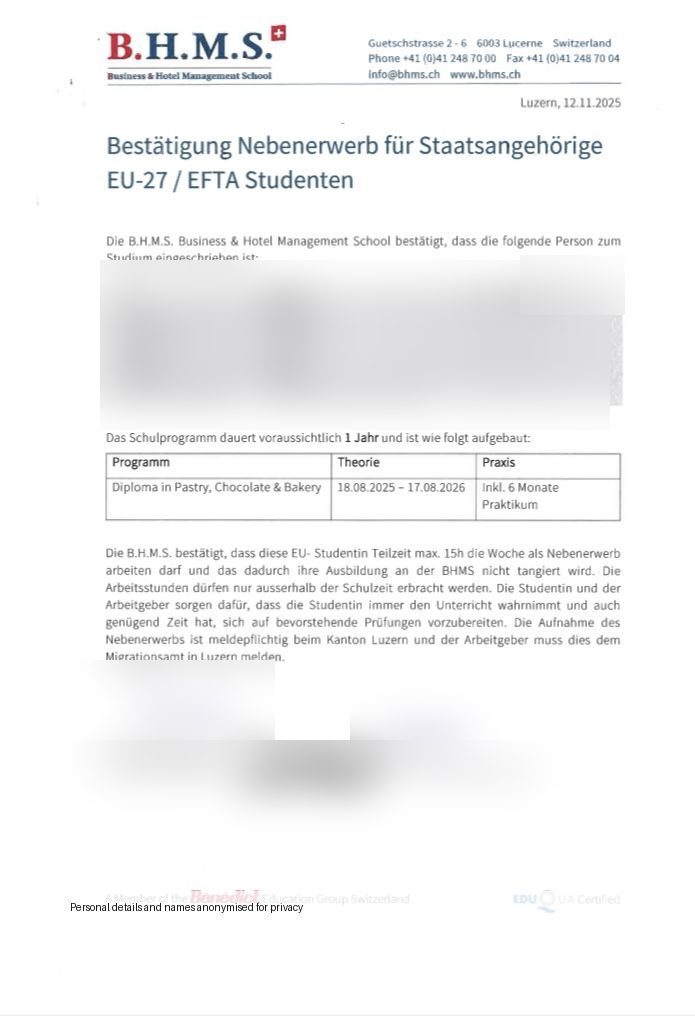
Career offices do not only help with paperwork. They can also guide students toward jobs that fit their timetable, language level, location and legal status. Of course, you can also ask me to help you look for the perfect student job based on your location, schedule and career goals.
Example document provided for educational illustration only. Eligibility for student work always depends on nationality, permit status, study status, employer requirements and cantonal approval or notification rules.
Canton-by-canton summary
The core rule is federal, but each canton manages its own procedure, forms and authority. Always check the canton where the student lives and works. SEM maintains the official directory of cantonal immigration and labour-market authorities. Source: SEM – cantonal authorities directory.
| Canton | Practical student work rule | What changes locally |
|---|---|---|
| Zurich | 15 h/week during term; full-time during breaks subject to rules | Employer-led procedure through Zurich labour/migration authorities |
| Bern | Same federal rule | Cantonal migration and labour forms |
| Lucerne | Same federal rule | Important for city-campus students in Lucerne |
| Uri | Same federal rule | Cantonal procedure |
| Schwyz | Same federal rule | Cantonal procedure |
| Obwalden | Same federal rule | Cantonal procedure |
| Nidwalden | Same federal rule | Cantonal procedure |
| Glarus | Same federal rule | Cantonal procedure |
| Zug | Same federal rule | Cantonal procedure |
| Fribourg | Same federal rule | Cantonal procedure |
| Solothurn | Same federal rule | Cantonal procedure |
| Basel-Stadt | Same federal rule | Local labour-market authority approval |
| Basel-Landschaft | Same federal rule | Cantonal procedure |
| Schaffhausen | Same federal rule | Cantonal procedure |
| Appenzell Ausserrhoden | Same federal rule | Cantonal procedure |
| Appenzell Innerrhoden | Same federal rule | Cantonal procedure |
| St. Gallen | Same federal rule | Cantonal procedure |
| Graubünden | Same federal rule | Cantonal procedure |
| Aargau | Same federal rule | Cantonal procedure |
| Thurgau | Same federal rule | Cantonal procedure |
| Ticino | Same federal rule | Italian-language cantonal procedure |
| Vaud | 15 h/week; full-time during holidays | SPOP and employment-authority approval process |
| Valais | Same federal rule | Cantonal procedure |
| Neuchâtel | Same federal rule | Cantonal procedure |
| Geneva | 15 h/week; 40 h/week during university holidays | OCPM Form E; non-EU students must wait for decision |
| Jura | Same federal rule | Cantonal procedure |
Visa and permit types explained
A visa is permission to enter Switzerland. A residence permit is permission to stay. Many non-EU/EFTA students need a national visa before arrival and then receive a residence permit after entering Switzerland. The Swiss government explains Swiss entry and stay categories through the official ch.ch portal. Source: ch.ch – visas and entry.
B permit: A B permit is a residence permit. For students, it is important not to confuse a student B permit with a work-based B permit. If the B permit was issued for study purposes, the 15-hour student-work rule and the canton’s approval/notification process still matter.
L permit: An L permit is a short-term residence permit. It is often used for shorter stays or short employment situations. For students, the practical issue is not only the letter on the permit but the purpose of stay and the conditions attached to it.
After graduation: Some graduates may request a short job-search residence stay after completing a Swiss higher-education programme. During that period, accessory work may be limited and must be checked with the canton. Vaud, for example, states that during the six-month job-search stay, accessory work may be authorised up to 15 hours per week. Source: Canton Vaud – Swiss higher-education graduates.
What student jobs are realistic?
Students should be realistic. Student jobs are often practical, local and entry-level. They are not usually luxury career positions. That does not make them useless. These jobs can build punctuality, confidence, language practice, Swiss employer references and independent income.
| Job type | Why it can be useful | Reality check |
|---|---|---|
| Restaurant, café or fast food | Service skills, speed, customer communication | Can include evenings, weekends and physical work |
| Hotel service or events | Directly relevant to hospitality students | Schedules may depend on events and seasonal demand |
| Retail assistant | Customer-facing Swiss work experience | Language skills may matter |
| Supermarket logistics / warehouse | Practical income and reliability | Often not glamorous but can be steady |
| University assistant | Academic environment and references | Often competitive and limited |
| Internship | Career-relevant experience | Must match study and permit rules |
Real examples of student jobs available in Switzerland
The following screenshots are not a guarantee that a specific student can apply or be hired. They are simply two examples of available student-type job listings found on 16 June 2026 on jobs.ch, Switzerland’s largest employment platform. Eligibility always depends on nationality, permit status, language skills, employer requirements and canton approval.
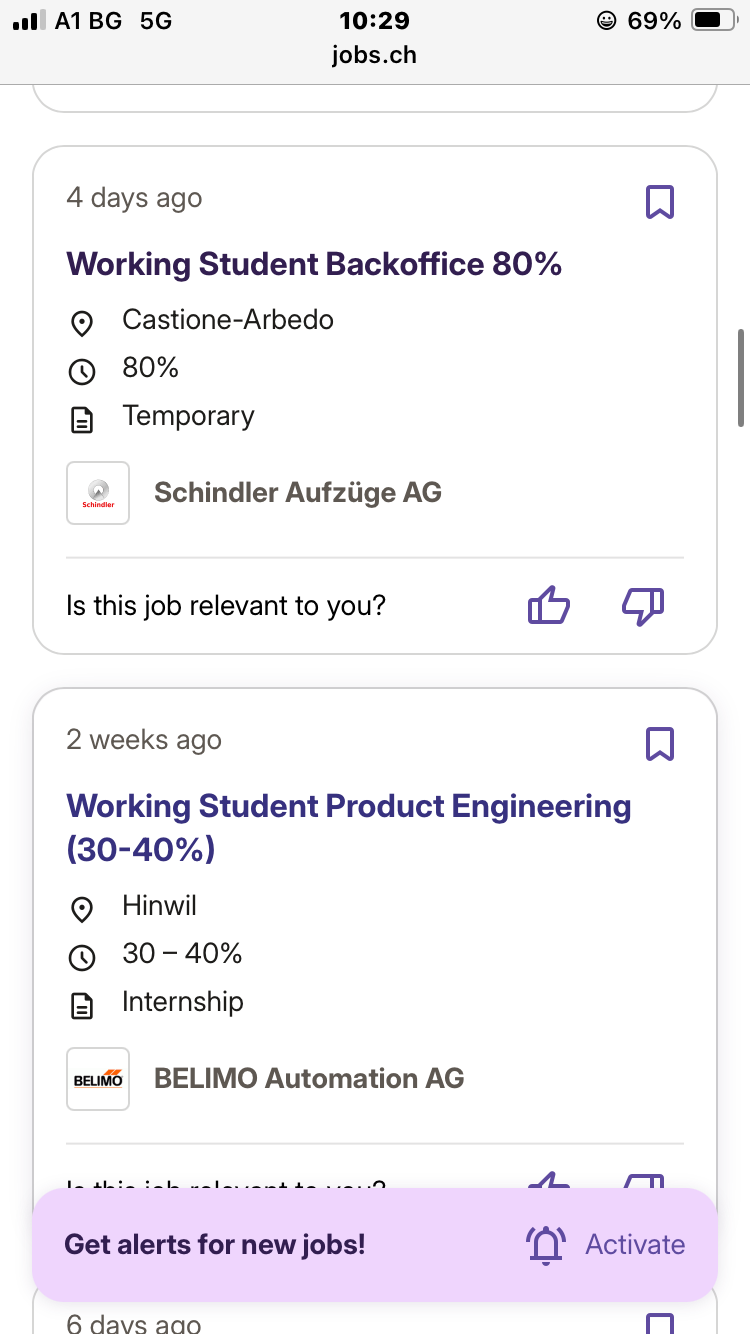
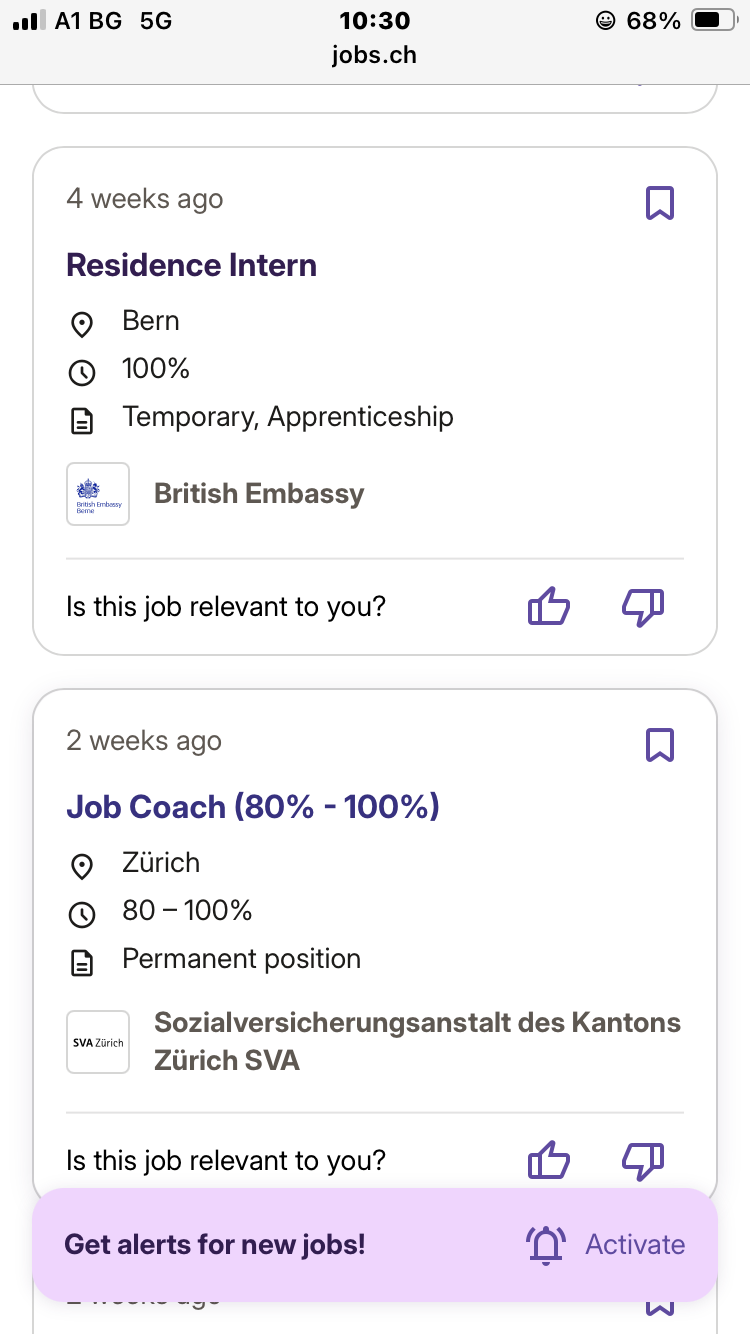
Source: jobs.ch listings viewed on 16 June 2026. Availability and eligibility requirements may change. International students must comply with the Swiss work regulations applicable to their nationality, residence permit and study status.
Hourly salaries and salary sources for student jobs
Switzerland has no national minimum wage, but some cantons do have cantonal minimum wages. The official ch.ch portal explains this clearly and links to salary tools. Source: ch.ch – minimum wage and average salary.
| Source | What it helps with | Official? |
|---|---|---|
| FSO Salarium | Official Swiss wage calculator by region, sector, occupation and profile | Yes |
| SECO wage calculator | Official wage benchmark / customary salary checks | Yes |
| ch.ch salary page | Plain-language official explanation of wages and minimum wages | Yes |
| jobs.ch salary calculator | Market salary indications from a major Swiss job platform | No, market source |
| jobup.ch salary info | Market salary indications, useful in French-speaking Switzerland | No, market source |
FAQ
Can international students work while studying in Switzerland?
Yes. International students can usually work in Switzerland during their studies, but the rules depend on nationality, permit status and cantonal approval. EU/EFTA students normally have simpler procedures, while non-EU/EFTA students usually need to wait six months and require employer-led authorisation before starting regular student work.
How many hours can students work in Switzerland?
As a general rule, eligible students may work up to 15 hours per week during academic semesters and full-time during official semester breaks. Students should always check the rule with their school career office and the canton where they live and work.
Can non-EU students work in Switzerland during their studies?
Yes, but non-EU/EFTA students normally cannot begin regular supplementary work immediately. In most cases they may start only after six months of study, and the employer must request authorisation from the competent cantonal authority before the student starts working.
Can EU/EFTA students work immediately after arriving in Switzerland?
EU/EFTA students usually have easier labour-market access than non-EU/EFTA students, but paid work still has to be correctly registered or notified according to the local canton and student residence rules. They should not assume that student status means unlimited work.
Do Swiss hospitality schools help students find part-time jobs?
Many Swiss hospitality and business schools have career offices that help students with documents required for legal student employment. They may also guide students toward suitable roles that fit their timetable, language level, location and permit status.
Can hospitality students realistically combine studies and student work?
Yes, especially at city campuses such as Lucerne, Zurich or Montreux, where students are close to employers. Based on Silvia Batkova’s experience supporting more than 100 students, part-time work is much less realistic for students who live on remote mountain campuses and need long commutes for short shifts.
What types of student jobs are common in Switzerland?
Common student jobs include restaurant and café work, fast food, hotel service, events, retail, supermarket logistics, warehouse support, university assistant roles and back-office work. These jobs are often practical rather than glamorous, but they build Swiss experience and employer references.
Do student jobs help future careers?
Yes. Student jobs can improve a CV by adding Swiss work experience, references, punctuality, customer-service skills, language practice, confidence and real-life workplace discipline. They complement paid internship semesters rather than replacing them.
Do mountain-campus students have the same opportunities to work as city-campus students?
Legally the rules are similar, but practically the opportunities are not always equal. Students on mountain campuses may have fewer nearby employers and may need long travel times to reach city jobs, which makes regular semester work less attractive.
Can student work help reduce the cost of studying in Switzerland?
Student work can help with pocket money, food, transport and some living expenses. It should not be treated as a guaranteed way to pay the full cost of Swiss education, but it can improve independence and support a faster return on investment for self-sponsored students.
Need help choosing a Swiss study path?
Silvia helps families compare Swiss business and hospitality programmes, city vs mountain campuses, internships, student work reality, costs and long-term return on investment.